
A story that matters to businesses
For many years, intellectual property was viewed by companies primarily as a legal matter. Registering a trademark, filing a patent, protecting a design or checking the availability of a name were activities generally addressed when a new product was launched, a company entered a new market or a problem emerged.
Technology is now fundamentally changing this approach.
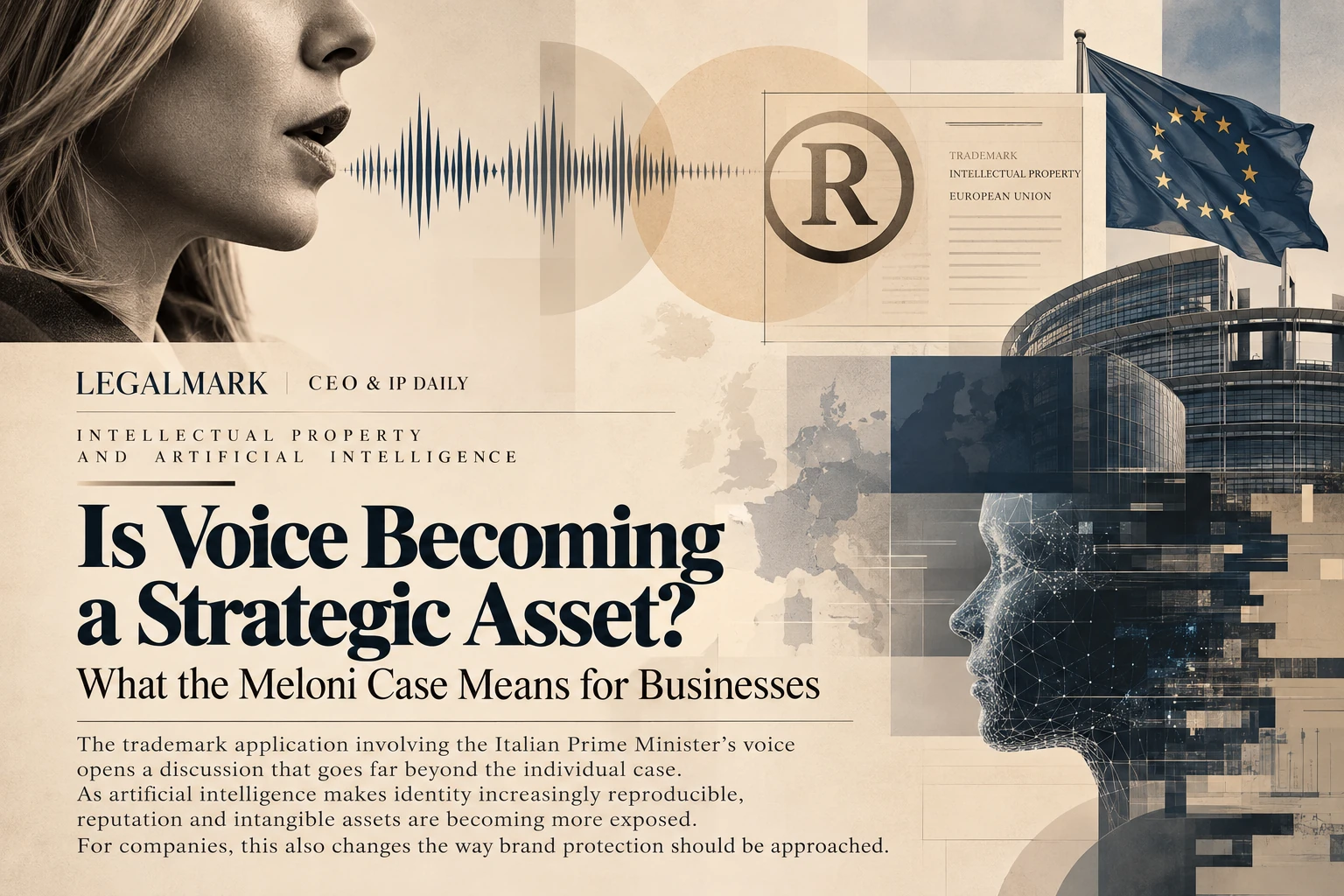
The recent news surrounding Giorgia Meloni's application for protection of her voice as a European trademark offers an interesting perspective for the business community. The application was filed with the EUIPO on October 5, 2026 and, according to Reuters, includes a four-second audio recording. The procedure is still under review, and a trademark application does not automatically create absolute protection against every possible use of a person's voice.
The case nevertheless brings a question to the forefront: what happens when an element of identity can become an asset while, at the same time, being artificially reproduced?
When identity becomes an asset
The issue concerns a political figure today, but the underlying challenge potentially affects companies and executives as well. Generative artificial intelligence has dramatically reduced the cost and complexity of producing images, videos and audio content. A voice can be replicated, a face can be reconstructed and a message can be generated with a level of realism that would have been difficult to imagine only a few years ago.
The consequence is significant. Identity protection can no longer be viewed exclusively as a personal matter. In certain circumstances, it becomes a matter of brand, reputation and corporate value.
A brand is not simply a name registered with a trademark office. Its value is created through a combination of elements: name, logo, design, packaging, colours, communications, reputation and, in some cases, distinctive audio or audiovisual elements.
Corporate capital is becoming increasingly intangible
According to the World Intangible Investment Highlights 2026 published by WIPO and Luiss Business School, global investment in intangible assets exceeded USD 10 trillion in 2025 for the first time. The study, covering 29 economies, also finds that intangible investment has grown more than three times faster than tangible investment since 2008.
The data point to a structural change: an increasing share of economic value is built through knowledge, software, data, research and development, design, brands and other intangible assets.
Yet there remains a significant asymmetry in corporate management. Companies generally know the value of their real estate, equipment and financial resources. Much less frequently do they have an equally clear picture of their intellectual-property portfolio.
The question every CEO should ask
How many trademarks does the company own? In which countries are they protected? Which patents are actually being exploited? Which assets could be licensed? Which could be transferred or valued? Which distinctive elements are being used commercially without an adequate protection strategy?
These questions become particularly important when a company enters a growth phase or prepares for a strategic transaction. International expansion, the development of a franchise network, the entry of an investor, an acquisition or the sale of a brand can transform intellectual property from a simple protective mechanism into a genuine component of the company's financial and commercial strategy.
This is where the question a CEO should ask also changes.
Not simply: "How much does it cost to register this trademark?"
But: "What value am I protecting?"
The difference is not merely semantic. In the first case, intellectual property is perceived as a cost. In the second, it is recognised for what it can become: a strategic corporate asset.
AI and brand protection: a strategic issue
Artificial intelligence makes this transformation even more evident. When technology makes it easier to reproduce a distinctive element, the importance of properly identifying and protecting that element increases at the same time.
This does not mean that every voice, image or communication element can automatically become a trademark, nor that registration alone resolves every possible legal issue. Protection depends on the nature of the asset, the rights involved, the territories concerned and the specific circumstances.
It does mean that management should begin to look at intellectual property through a broader lens. Trademarks, patents, designs, software, domains, know-how and other distinctive assets can contribute to corporate value and, in appropriate circumstances, can be protected, licensed, transferred, valued or commercialised.
From legal cost to strategic asset
The real issue, therefore, is not simply whether a voice can be registered as a trademark. The case is better understood as a signal of a deeper transformation: identity itself is becoming increasingly economic and strategic in nature.
For a CEO, this means beginning to look at the company's intangible assets with the same attention given to other corporate assets. It means understanding what makes the business recognisable, which elements are protected, in which markets they are protected, which assets may generate additional commercial opportunities and where significant risks may still exist.
In the years ahead, this reflection could become increasingly important in boardrooms, M&A transactions and corporate valuations. Because the value of a company depends not only on what it physically owns, but also on its ability to transform knowledge, innovation and identity into assets that are unique, recognisable, defensible and transferable.
LegalMark's question
If an investor asked you tomorrow to identify the ten most important intangible assets of your company and explain what they are worth, would you be able to answer?
If the answer were no, the problem might not simply be the absence of a registration. It might point to the absence of a genuine intellectual-property strategy.
Reuters, October 5, 2026 — Italy PM Meloni seeks EU trademark for her voice amid AI deepfake risks.
WIPO & Luiss Business School, 2026 — World Intangible Investment Highlights 2026.
General editorial and informational content. Registrability and protection depend on the specific circumstances and applicable law.